

Home Remedies vs. Prescription Toenail Fungus Treatment: Which Works Better?
Key Takeaways
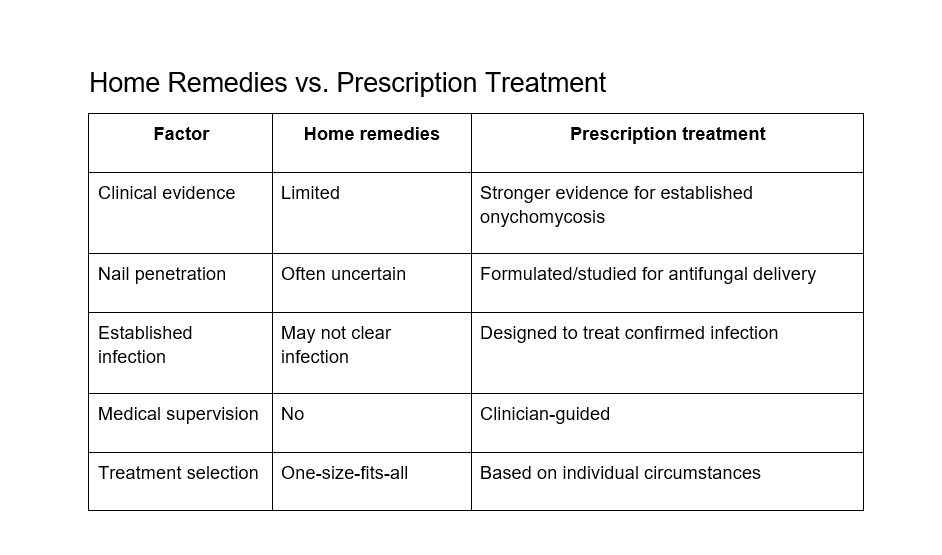
Home remedies for toenail fungus may support nail and foot hygiene but have limited evidence for clearing established onychomycosis.
Prescription oral antifungals such as terbinafine have stronger clinical evidence than most home-based approaches.
Prescription topical treatment may be appropriate for selected infections and can complement oral therapy.
STRIDE DUO™ combines prescription oral and topical treatment through a “top-down + bottom-up "approach designed to address multiple treatment barriers. STRIDEDUO™ combines prescription oral terbinafine with ClearNail Renewal™ topical treatment in a complementary oral + topical approach.
A clinician should evaluate suspected toenail fungus before prescription treatment because not every thick or discolored nail is caused by fungus.
Toenail fungus, medically known as onychomycosis, can be frustrating to treat. A discolored or thickened nail may initially seem like a cosmetic concern, leading many people to try household ingredients or over-the-counter products. However, once fungus becomes established within or beneath the nail, surface-level approaches may not be enough.
The important question is not simply whether a remedy can improve the nail's appearance. It is whether the treatment can reach and clear the infection. For established onychomycosis, prescription antifungal treatment generally has stronger evidence than home remedies, particularly when the infection is extensive, persistent, or recurrent. Oral terbinafine, for example, is considered a first-line treatment for many appropriate patients. (Source)
What Are Home Remedies for Toenail Fungus?
A lot of suggestions on home remedies for toenail fungus involve the use of vinegar, tea tree oil, essential oils, and baking soda, among other common home items. While some substances have demonstrated antifungal properties in a laboratory, it is important to note that when it comes to prevention, basic foot-care habits such as maintaining dry feet and clean nails are key in reducing the risk of moisture buildup and reinfection.
However, laboratory activity does not necessarily translate into a clinical cure. Toenail fungus can exist within and beneath the nail, while the nail plate's dense keratin structure can make penetration difficult. Effective treatment therefore depends on the extent and location of the infection rather than simply whether an ingredient can inhibit fungi in a laboratory.
It is also important to distinguish prevention from treatment. Keeping feet dry, avoiding shared nail tools, and maintaining clean footwear can help reduce exposure and reinfection, but these measures do not eliminate an established fungal infection.
Why Prescription Toenail Fungus Treatment May Work Better
Prescription treatment allows a clinician to consider the infection's severity, number of affected nails, medical history, potential drug interactions, and other factors before selecting an appropriate treatment.
Oral antifungals have an important advantage: they reach the nail through systemic circulation rather than relying entirely on penetration through the nail plate. Oral terbinafine is widely considered a first-line option for appropriate patients and has demonstrated greater effectiveness than many topical therapies. (Source)
Prescription topical treatment can also play an important role. It delivers antifungal medication directly to the affected nail and may be appropriate for selected infections oras part of a broader treatment strategy.
Combination Treatment: A Top-Down + Bottom-Up Approach
STRIDE DUO™ is designed around a clinically engineered top-down+ bottom-up approach. It combines prescription oral antifungal therapy with STRIDE™ Clear Nail Renewal™ topical treatment rather than treating them as two unrelated options.
STRIDE DUO™ is designed to overcome three main barriers to treatment: the nail's keratin shield, fungal biofilm protection, and dormant spores that can contribute to reinfection. The combination approach is intended to address the challenge of treating fungus within and beneath the nail while also delivering treatment directly to the affected nail surface.
What Is ClearNail Renewal™?
ClearNail Renewal™ is STRIDE's prescription topical component. Its formulation includes Urea, Lactic Acid, Terbinafine, and DMSO.
These ingredients support the topical treatment strategy. Urea and lactic acid help address the nail's thickened surface, while terbinafine provides antifungal activity and DMSO functions as apenetration-enhancing ingredient.
What About Pulse Dosing?
Concerns about taking oral antifungals continuously are understandable. STRIDE uses a pulse-dosing protocol for terbinafine when clinically appropriate, involving short periods of medication followed by extended breaks. The STRIDE protocol describes 7 days on followed by approximately 90 days off, with the exact regimen determined by the prescribing clinician. STRIDE uses a pulse-dosing protocol for terbinafine when clinically appropriate. The STRIDE DUO protocol provides terbinafine 250mg, two tablets daily for 7 days, with the course repeated approximately every 90 days as directed by the prescribing clinician.
Terbinafine can persist in nail keratin after dosing, which provides a rationale for pulse-based approaches. However, pulse dosing is not appropriate for everyone, and evidence has not established that it is universally superior to continuous treatment.
A licensed provider should determine whether this approach is suitable based on the patient's medical history and clinical circumstances.
When Should You Consider Prescription Treatment?
Home care and preventive habits can remain useful, but they should not replace medical treatment when an established infection is present.
Prescription treatment may be worth discussing when the infection:
· Affects multiple toenails
· Causes significant thickening or nail separation
· Has persisted despite previous treatment attempts
· Continues to return after appearing to improve
· Involves a larger portion of the nail or the nail matrix
Because toenails grow slowly, clearing the fungus and seeing a completely healthy nail are not the same event. Even after successful treatment, the damaged portion must grow out, and complete toenail regrowth can take many months.
If you suspect toenail fungus, an online clinical evaluation can help determine whether prescription treatment is appropriate for you.
See If You Qualify for a clinician-reviewed STRIDE™ treatment plan.
FAQs
1. Can home remedies cure toenail fungus?
There is limited clinical evidence that common home remedies can reliably clear established toenail fungus. Foot hygiene and keeping nails dry can help reduce moisture and reinfection risks, but confirmed onychomycosis often requires evidence-based antifungal treatment.
2. What is the most effective treatment fortoenail fungus?
The appropriate treatment depends on the severity of the infection and the patient's medical history. Prescription oral antifungals such as terbinafine are commonly used for appropriate patients, while prescription topical treatment may be suitable for selected cases or as part of a combination approach.
3. Are prescription antifungals better than home remedies for toenail fungus?
Prescription antifungals have substantially stronger clinical evidence for treating established onychomycosis than most household remedies. Oral treatment can reach the nail systemically, while prescription topical medications are formulated to deliver antifungal treatment to the affected nail.
4. What is pulse dosing for toenail fungus?
During pulse dosing, an oral antifungal drug is taken fora specified period of time and then followed by a lengthy period of no use. The clinicians at STRIDE have established a protocol for using this treatment that calls for taking the antifungal for a week and then remaining off of it for about 90 days.
5. What are the three barriers to treatingtoenail fungus?
Toenail fungus can be difficult to treat because of three key barriers: the nail's dense keratin structure, fungal biofilm protection, and dormant spores that can contribute to reinfection. STRIDE DUO™ is designed to address these barriers through its combination treatment approach. Toenail fungus can be difficult to treat because medication must reach fungus within and beneath a dense nail plate and because recurrence is common. STRIDE DUO™ combines oral and topical treatment to approach the infection from two directions.
Ready To Cure Toenail Fungus For Good?
- Jeff S.