
.jpg)
Prescription Toenail Fungus Treatment vs. Over-the-Counter Options: What's the Difference?
Key Takeaways
Over-the-counter products may help with mild fungal infections or improve the appearance of the nail, but they often struggle to treat established toenail fungus.
Prescription oral antifungal medications remain the standard treatment for moderate to severe onychomycosis.
The biggest difference isn't necessarily the medication itself—it's whether the treatment can reach the fungus beneath the nail.
Combination therapy using both oral and topical treatment is often recommended for more advanced infections.
Introduction
Walk into any pharmacy and you'll find shelves full of products claiming totreat toenail fungus. Creams, liquids, oils, and medicated solutions are widelyavailable without a prescription, and many are marketed as an easy alternativeto seeing a doctor.
So why do so many people still struggle with toenail fungus after months ofself-treatment?
The answer usually comes down to one simple question:
Can the medication actually reach the fungus?
Understanding where the infection lives and how different treatments work helpsexplain why prescription therapies often produce better results thanover-the-counter products for established infections.
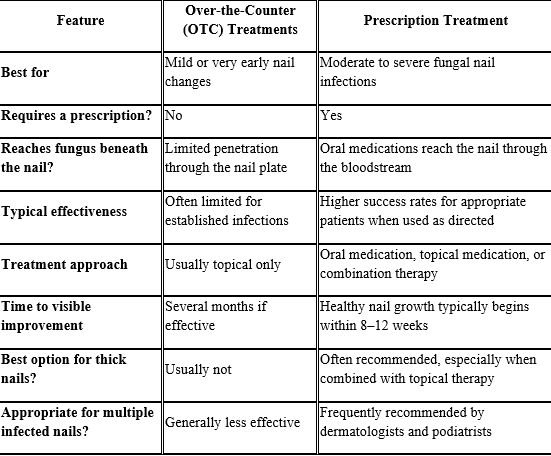
Prescription vs. OTC Toenail Fungus Treatments at a Glance
Why Over-the-Counter Treatments Often Fall Short
Many over-the-counter products are applied directly to the surface of thenail.
That sounds logical, but toenail fungus rarely remains on the surface forlong.
As the infection progresses, fungal organisms spread beneath the nail plateand into the nail bed. Once this happens, the thickened nail becomes a barrierthat limits how much medication reaches the infection.
Some topical products may be helpful for very mild infections or fungalinfections involving only the skin around the nail. However, once the nailbecomes thick, yellow, brittle, or begins separating from the nail bed, topicaltreatment alone often becomes much less effective.
A review published by the Cochrane Collaboration found thatwhile some prescription topical medications can benefit selected patients, oralantifungal medications generally provide higher cure rates because they reachthe fungus from within the growing nail.
Why Prescription Treatments Are More Effective
Prescription treatments take a different approach.
Oral medications such as terbinafine are absorbed into thebloodstream and incorporated into the nail as it grows. Instead of trying topenetrate through the hardened nail plate, the medication reaches the infectionfrom inside the body.
According to the American Academy of Family Physicians,oral terbinafine remains the preferred first-line treatment for most patientswith toenail fungus because of its effectiveness and established safety profilewhen used appropriately.
It's important to recognize, however, that treatment success depends on manyfactors.
Patients with thickened nails, multiple infected nails, diabetes, reducedcirculation, or years of untreated infection often experience lower cure ratesthan those reported in clinical trials. That's why setting realisticexpectations is just as important as choosing the right medication.
Why Many Specialists Recommend Combination Therapy
For moderate to severe infections, many dermatologists and podiatristsrecommend combining oral medication with a topical treatment.
Each therapy addresses a different part of the problem.
The oral medication reaches fungus growing beneath the nail, while thetopical solution helps reduce fungal organisms on the surface of the nail andsurrounding tissue.
Rather than relying on one treatment alone, combination therapy attacks theinfection from multiple directions and may improve overall treatment success inappropriate patients.
At STRIDE, we've built our treatment protocol around this same philosophy.STRIDE DUO™ combines pulse-dose oral terbinafine with STRIDE ClearNailRenewal™, a compounded topical solution designed to penetrate the nail plate whileoral therapy works from within.
When Is It Time to See a Healthcare Provider?
Many people spend months trying one over-the-counter product after anotherbefore seeking medical advice.
You should consider seeing a healthcare provider if:
- The infection has been been present for several months.
- More than one nail is affected.
- The nail has become thick, brittle, painful, or begins lifting from the nail bed.
- You have diabetes, poor circulation, or a weakened immune system.
- You've used OTC products consistently without improvement.
Not every abnormal nail is caused by fungus, so confirming the diagnosisbefore beginning treatment is an important first step.
Prescription Doesn't Mean Instant Results
One of the biggest misconceptions is that prescription medication shouldmake the nail look normal within a few weeks.
Unfortunately, that's not how toenail fungus works.
The medication eliminates the fungus first. The damaged nail must then growout and be replaced by healthy nail.
Most patients begin seeing healthy nail growth within 8–12 weeks,while complete replacement of the damaged nail typically takes 9–12months, depending on the severity of the infection and how quickly thenail grows.
Consistency not speed is one of the strongest predictors of success.
The Bottom Line
Over the counter (OTC) toenail fungus treatments can be a reasonablestarting point for mild or early infections, but they have importantlimitations once the fungus becomes established beneath the nail.
Prescription oral antifungal medications remain the standard of care treatmentfor moderate to severe infections because they can reach the fungus from insidethe growing nail. For the best results combining oral therapy with apenetrating topical solution provides a more comprehensive approach thanrelying on topical treatment alone.
At STRIDE, we've treated thousands of patient cases and have found thatsuccessful treatment is about more than prescribing medication. Accuratediagnosis, realistic expectations, consistency, and preventing reinfection allplay an important role in achieving healthy, fungus-free nails.
Ready To Cure Toenail Fungus For Good?
- Jeff S.